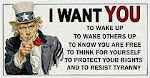

Valuable quotes

"No person is your friend who demands your silence, or denies your right to grow." ~~


"The minute you start talking about what you're going to do if you lose, you've already lost." ~~


Cree Prophecy - "When all the trees have been cut down, when all the animals have been hunted, when all the waters are polluted, when all the air is unsafe to breathe, only then will you discover you cannot eat money." ~~


Showing posts with label Books worth reading. Show all posts

Monday, February 22, 2010

REPUBLICAN PARTY, RED FROM THE START

While Republicans wail nowadays about how Marxist the Democratic party is & how they are turning the country into a socialist nation, let's take a look at the real Marxist party shall we? Who really has ties with Marx, Communism & to a degree socialist states.

The Republican lament these days is that the country is moving away from it's core values & has “lost its way” & “gone wrong.” It has “diverged” from the fiscally responsible, small government philosophy of Republican heroes like Robert Taft whom Eisenhower’s handlers finagled out of the nomination for President in 1952.

We're now told this is why today’s Republican Establishment hates Dr. Ron Paul with such a passion; that they hate him because, like Taft, he is the quintessential Republican. Patriots who say that are mistaken, of course.
The reason the Republican Establishment hates Dr. Paul is precisely that he is *not* a traditional, mainstream Republican - that his platform of freedom is an aberration. The Republican Party didn’t “go wrong,” didn’t “go left” , didn't go any direction. It has been wrong from the beginning, from the day it was founded.


From the very beginning, the Republican Party has worked without deviation for bigger, more imperial government, for higher taxes, for more wars, for more totalitarianism. From the beginning, the Republican Party has been Red.
Why? In 1848, Communists rose in revolution across Europe, united by a document prepared for the purpose, entitled Manifesto of the Communist Party. It's author was the degenerate Karl Marx, whom a small gang of wealthy Communists – the League of Just Men – hired for the purpose. The Manifesto told its adherents & its victims what the Communists would do.

But the Revolution of 1848 failed. The perpetrators escaped, traveled where else but to the United States.

In 1856, the Republican Party ran its first candidate for President. By that time, the Communists from Europe had thoroughly infiltrated this country, especially the North. Many became high ranking officers in the Union Army - top government officials.

Down through the decades, Americans have wondered about the Yankee brutality in that war. Lee invaded the North, but that sublime Christian hero forbade any forays against civilians. Military genius Stonewall Jackson stood like a stone wall, routed the Yankees at Manassas, but when Barbara Frietchie insisted on flying the Yankee flag in Frederick, Maryland, rather than the Stars & Bars, that sublime Christian hero commanded, according to John Greenleaf Whittier, “‘Who touches a hair of yon gray head/dies like a dog! March on!’ he said.”

But the Yankees, invading the South, were monsters, killing, raping & destroying civilian property. In one Georgia town, some 400 women were penned up in the town square in the July heat for almost a week without food, water or access to toilets of any kind. And it got worse when the Yankees got into the liquor. Some two thousand southern women & children were then shipped north to labor as slaves.

Sherman’s scorched earth March to the Sea was a horror even the later Nazis could not equal. Why? Because the Yankees hated Negro slavery so much? There can be no doubt that the already strong Communist influence in the North, combined with that of the maniacal abolitionists, was at least one of the main reasons. Slavery was a handy excuse, an afterthought they introduced to gain propaganda traction.
In retrospect, it appears that because nothing like this had ever happened in this country before, Lee & Jackson did not fully comprehend what they were fighting. Had this really been a “Civil” War, rather than a secession, they would & could easily have seized Washington after Manassas & hanged the first "Communist President" along with the other war criminals. Instead they went home, in the mistaken belief that the defeated Yankees would leave them alone. Lee did come to understand, but too late. He said after the war that had he known at the beginning what he had since found out, he would have fought to the last man.

What was the South fighting? Alexander Hamilton was the nation’s first big government politician. Hamilton wanted a strong central government & a national bank. Vice President Aaron Burr killed Hamilton in a duel. The problem was that Burr didn’t kill him soon enough. Henry Clay inherited & expanded Hamilton’s ideas in something called the “American System,” which advocated big government subsidies for favored industries & high, ruinous tariffs, what we today call “socialism for the rich.” Clay inspired smooth talking railroad lawyer Abraham Lincoln, who inherited the Red escapees from the Revolution of 1848 & became our first 'Communist' President.
All of this comes again to mind with the recent publication of Red Republicans: Marxism in the Civil War and Lincoln’s Marxists (2007) by Southern historians Walter D. Kennedy & Al Benson, Jr. Don't believe me, then read this book, because it irrefutably nails down everything I've said above & then some. Take a peek through the Red Republicans, & remember that the reason most Americans have never heard of all this is because it's the winner writing the history.

For instance, August Willich was a member of the London Communist League with Karl Marx & Friedrich Engels. Needless to say, Willich became a major general in the Union Army. Robert Rosa belonged to the New York Communist Club & was a major in the 45th New York Infantry. Brigadier general Louis Blenker of New York was a “convinced Marxist.” His 10,000 man division looted people in Virginia, inspiring the term “Blenkered.” Many of his men were fresh from European prisons. Our first Communist President knew this, but turned them loose on the people of the South.

In Red Republicans you'll learn of nine European revolutionaries convicted of treason & banished to Australia. They escaped to the united States & Canada. I took this in school so am familiar with all this. Three or four of them, with no military experience, became Union generals, joining at least three other Marx confidants who already held that rank. “Every man of the nine became a member of the Canadian Parliament, a governor of a territory or state in the Union, party leader, prime minister or attorney general.”

Many of these men, though not all, were Germans, some four thousand of whom escaped to this country. Known as Forty-Eighters, they quickly added violent abolitionism & feminism to their Communist beliefs. In Missouri, Forty-Eighter Franz Sigel became a Union general & had uniforms made for his Third Infantry Regiment that closely resembled the uniforms worn by socialist revolutionaries in Germany in 1849. Forty-Eighters who became high ranking Union commanders included Colonel Friedrich Salomon, Ninth Wisconsin, Colonel Fritz Anneke, Thirty Fourth Wisconsin & Colonel Konrad Krez, Twenty Seventh Wisconsin. Communist journalist Karl Heinzen wrote: “If you have to blow up half a continent & cause a bloodbath to destroy the party of barbarism, you should have no scruples of conscience. Anyone who would not joyously sacrifice his life for the satisfaction of exterminating a million barbarians is not a true republican.” Heinzen came to this country & supported Lincoln.

Joseph Weydemeyer had to flee Germany when the Communist Revolution failed. In London he belonged to the Communist League & was a close friend of both Marx & Engels. He came to this country in 1851, supported Lincoln, maintained his close friendship with Marx & became a Brigadier General in the Union Army. Dedicated socialist Richard Hinton had to leave England. In this country he became a Union colonel, a Radical Republican & an associate of the maniac John Brown.
So was Allan Pinkerton, who financed him. At one meeting with Brown, Pinkerton told his son: “Look well upon that man. He is greater than Napoleon & just as great as George Washington.” Yes, Pinkerton was the great detective who founded the agency that bears his name. Why didn’t you know that?

In Kansas, mass murderer Brown enjoyed the support of wealthy Yankees (the Secret Six). August Bondi & Charles Kaiser, who worked with Brown there, were Forty Eighters.

What about Marx himself? Marx fled to England, where he is buried. He became the European correspondent for socialist Horace Greeley’s New York Tribune, whose Managing Editor, Charles Dana, was a Communist. Dana hired Marx as a foreign correspondent. Marx wrote often of his kinship with the new Republican Party. Dana’s generosity to Marx kept that scumbag alive. Remember that Marx never worked a day to support his family, but did find time to knock up their maid. Dana later became Assistant Secretary of War. All these people were in place when our first 'Communist' President was elected on the Republican ticket in 1860 & provoked Lincoln’s Communist War to Destroy the Union.

The GOP Convention of 1860 took place in Chicago, a flaming center of German Communism. Many such Reds were delegates, including Johann Bernhard Stallo & Frederick Hassaurek from Ohio & Heinrich Bornstein from Missouri, a very good friend of Marx. Socialist Carl Schurz was a delegate from Wisconsin. To guarantee German support in Illinois, Lincoln secretly bought the Illinois Staats Anzieger. After the election he awarded the editor a consular post.

Socialist Friedrich Kapp was editor of the New Yorker-Abendzeitung. He wrote propaganda for the new Republican Party & helped mightily to deliver the German-American vote to Lincoln. With other Forty-Eighters, he was an elector for Lincoln in 1860. Remember, these are just a few examples. You really need to read the book. I can't possibly give any more than an essence of its content here.

Keep in mind too that slavery, for these Communists, was just an afterthought, a tool. Before the War for Independence, it was the Southern colonies that petitioned the King to stop importing slaves into the South. Did you know that Jefferson tried to include in the Declaration of Independence a complaint against the King because his government had forbidden the colonies to end the slave trade? Jefferson’s language was deleted to avoid giving offense to New England, which was making buckets of money trading slaves. Did you also know that if slavery was what the South fought to defend, all it had to do was stay in the Union? Lincoln made clear that he would defend slavery & would not free slaves owned by a man in a state within the Union: [quote]“I have no purpose, directly or indirectly, to interfere with the institution of slavery in the States where it exists. I believe I have no lawful right to do so, and I have no inclination to do so.”[unquote]

Remember that the Emancipation Proclamation came well into the war. It was a propaganda stunt that freed only the slaves in areas controlled by the Confederacy; in other words, none. Meanwhile, prominent abolitionist Robert E. Lee, the first man Lincoln offered command of the Union Army, had freed his family’s slaves long before the war. So, what were the Communists who came here after? Republican Senator John Sherman, brother of the monster who Marched to the Sea, advised his fellow senators to “nationalize as much as possible [making] men love their country before their states. All private interests, all local interests, all banking interests, the interests of individuals, everything, should be subordinate now to the interests of the Government.”

Germany was a decentralized collection of independent states. The goal of the Forty Eighters there was a “united, indivisible republic” in which those states would be dissolved. Land & private industry would be confiscated. The government would be transformed into a Socialist dictatorship. These are the ideas the Forty Eighters came to implement here. By the way, that is what Hitler did in the 1930s. That is what the fleeing Communists found so attractive in Lincoln.

So, again, the Republican Party did not “go wrong.” It was rotten from the start. It has never been anything else but red. The characterization of Republican states as “red states” is quite appropriate. What do these revelations mean to us? Again, Dr. Paul is an aberration. He is not a “traditional Republican.” A “traditional Republican” stands for high taxes, imperial government & perpetual war. Pretty much what we've seen so far.

Monday, June 22, 2009

This is Your Brain on Music – the science of human obsession

It is funny how I initially came upon this book. Myself, along with a group of friends were sitting around talking one afternoon about how we eventually all seem to get stuck or trapped in our own generations music.I immediately thought about myself and questioned if there was perhaps a piece of generational gene that I’d not inherited, because I had definitely not stayed with my generations’ music. As new music is released I have moved along with it and embraced it. Perhaps it was because, for most of my life I have been a musician.

Or maybe it was because I could hear the recycled riffs and shared melody from past compositions that bridged the music from the past to the present. But it was that thought that led me to Googling the question “Why do we love our own generations’ music best?”And that search eventually led me to this book.

This is Your Brain on Music is pretty hard book to argue. Written by multi-hatted Daniel Levitin, you have to accept that the man knows where he’s coming from. Among the non-music related things he’s worked at professionally are a diverse and somewhat eclectic list of jobs. He worked as an automobile mechanic and as a graphic designer - a typographer, a chauffeur, product manager, data analyst, dishwasher, computer operator, television repairman, fry cook, standup comedian, door-to-door salesman, camp counselor and wood stove salesman.

Then in his thirties he returned to school and studied cognitive psychology/cognitive science, first at Stanford University (he received his B.A. in 1992 with honors and highest university distinction) and then the University of Oregon where he received his M.Sc. (1993) and Ph.D. (1996). He completed post-doctoral fellowships at Paul Allen's Silicon Valley think-tank Interval Research, at the Stanford University Medical School, and at the University of California, Berkeley.

He has been a visiting professor at the University of California, Berkeley, Stanford University, Dartmouth College and Oregon Health Sciences University. As a cognitive neuroscientist specializing in music perception and cognition, he is credited with fundamentally changing the way that scientists think about auditory memory, showing that long-term memory preserves many of the details of perceptual experience that previous theorists regarded as lost during the encoding process, and with drawing attention to the role of cerebellum in music listening, including tracking the beat and distinguishing familiar from unfamiliar music.

He has worked with the likes of the Grateful Dead, Santana, Steely Dan, Chris Isaak, Joe Satriani – just the beginnings of a very lengthy list of musicians. He has won awards from the Sundance Film Festival and Venice Film Festivals, and returning to university in the 70’s.

On the sound effects side of things he worked at A Broun Sound in San Rafael, California, building speaker cabinets for The Grateful Dead, for whom he later worked as a consulting record producer. He was invited and became one of the golden ears used in the first Dolby AC audio compression tests, a precursor to mp3 audio compression.

I know one of the first things out of people’s mouths is to wonder how dry this book is. Admittedly, the first part is a bit, but it’s by no means something that would put you to sleep. Not by a long shot.

Daniel writes in the introduction:

By better understanding what music is and where it comes from, we may be able to better understand our motives, fears, desires, memories and even communication in the broadest sense. Is music listening more along the lines of eating when you’re hungry, and thus satisfying an urge? Or is it more like seeing a beautiful sunset or getting a backrub, which triggers sensory pleasure systems in the brain? Why do people seem to get stuck in their musical tastes as they grow older and cease experimenting with new music? This is the story of how brains and music evolved --- what music can teach us about the brain, what the brain can teach us about music, and what both can teach us about ourselves

You will find that Daniel can tell a very good story. He imparts many in this book and you begin to wish you could have been a fly on a lot of walls during some of the times he tells about. You also come to understand yourself a little better and understand about things such as ear worms, that which makes songs stick in our heads for much too long sometimes. He tells about finger snapping and toe tapping and how they differ from each other. And he tells about meeting and working with John R Pierce who had also been noted for his work while serving as vice president of research at Bell Labs in New Jersey. He relates how Pierce asks him to explain rock and roll music to him, something Pierce had never paid attention to and didn’t understand.

Pierce requested that Levitin come up with six rock and roll songs that he felt would capture the essence of rock and roll. No easy feat! Levitin’s offerings were

1. “Long Tall Sally” – Little Richard
2. “Roll Over Beethoven” – The Beatles
3. “All along the Watchtower” – Jimi Hendrix
4. “Wonderful Tonight” – Eric Clapton
5. “Little Red Corvette” – Prince
6. “Anarchy in the U.K.” - the Sex Pistols.

This list alone has you going over in your head which six songs would you have picked? And if any one of yours is among the ones he picked?

This book surprised me because I thought I’d pretty much had a full understanding of the impact music had on my brain. But he opened whole new thoughts about that by bringing a scientific perspective to it. I caution that this book does not read like a text book, but it does talk about research on how the brain processes music and discusses things like pitch, timbre, rhythm, loudness and harmony and how they affect the human body.

If you have any interest in music whatsoever, I think this should be a book on your MUST READ list.

Friday, November 02, 2007

The Mephisto Club

Sixth in the series of Medical examiner Maura Isles and Boston City police detective Jane Rizzoli.

A few years back I joined an obscure little whodunit book club that literally gave us books to read, just so we could rate them. Nice work if you can get it, and I did. For a person such as myself who couldn’t keep myself in books, this was ideal. Oh yes, there were some kumquats to gnaw through, but for the most part, I had, to one degree or another, a retty good book to read when I was ready to relax for the evening. There were the exceptions to those kumquats too. One such non-kumquat was author Tess Gerritsen.

Fast forward to the present and Ms. Gerritsens sixth in her series of books featuring heroines Laura Isles and Jane Rizzoli. All the books in this series are stand-alone thrillers, as is The Mephisto Club. The title refers to a somewhat loosely knit organization of wealthy, but naive idealists who claim to seek out evil and try to strike it down. Or at least so they say.

The club’s acolytes devote themselves to the study and analysis of evil: is it able to be explained by science? And does it have an absolute physical presence? Do modern day demons walk the earth? Drawing on a wealth of dark historical data and mysterious religious symbology, the clubs scholars claim they can prove what they believe to be true - that Satan and his minions actually exist among us today. But is the club only investigating murders, or are they the target of the killings? Or do they emanate from it?

As the story opens, Medical examiner Maura Isles and Boston City police detective Jane Rizzoli find themselves involved in an unnerving Christmas Eve investigation. A murder in a rundown house in the city - a young woman brutally murdered and then meticulously dismembered by her killer. The words "I have sinned", written in blood, are left ominously scrawled above her on the wall, along with what seem to be religious symbols. This whole murder scene, the women feel, is one of the worst they’ve encountered over the course of their careers. How were they to know this was only the beginning?

Soon afterwards, a second murder victim is found and the whole scene has eerie similarities to the first, now also drawing the interests of The Beacon Hill Mephisto Club – a society of religious and crime historians with an unhealthy appetite for every gory detail, and headed up by the well-connected and very rich Anthony Sansone.

Also causing the women concern, is a phone call traced from the crime scene back to Jane's nemesis, psychologist Joyce O'Donnell. What this all points to, they have to find out and fast before any more deaths occur! In fact, as they investigate further, they begin to wonder if they themselves might be the next victims!

Tess Gerritsen can take you easily into her story. She is a qualified American physician and former anthropology student. During her studies at Stanford University, Tess developed a keen interest in ancient cultures as well as spending time studying the workings of the human body and human remains. It’s this combination of interests that led her into writing, affording her an opportunity to develop stories from her studies as well as through her travels. Her first-hand experiences in autopsy rooms and the medical professional comes through expertly in her writing.

There are some glitches in the plot, however nothing major, and the story stands up and is riveting and hard to put down. If you liked Da Vinci Code, you will thoroughly enjoy this book! A powerful story that I wouldn’t be surprised to see made into a movie. Unsettling and edgy – just what you expect from a good thriller.

Wednesday, October 10, 2007

Echo Park

Readers of Michael Connelly’s Hieronymus [Harry] Bosch series will be happy that the 12th in the series Echo Park has now been released in soft cover. And I’m happy to report it’s another great read from cover to cover. Great plot, and the tale moves along rather crisply.

I haven’t had the chance to catch up with Harry over these long summer months, but then Harry isn’t that hard to catch these days, having reached his 60’s and slowing a bit after coming out of retirement. That’s not to say he’s lost his edge though, just that his edge has softened a little, along with his middle and his eyesight.

Echo Park finds Harry back on the job, this time assigned to cold cases division in LAPD’s Open and Unsolved Cases Unit. He begins digging out old cases he personally had never been able to close - one such case that had plagued him for thirteen years – the case of a missing young woman, Marie Gesto. Over the years, Harry had occasionally pulled the file on Gesto fearing it was a murder but never having proof. No evidence and no body to give himself or Maria’s parents closure.

So when Harry learns that a killer, apprehended for several other crimes, has recently confessed to the Marie Gesto murder, he is both stunned and more than a little skeptical.
Harry's brought in to take the man's confession, since he and his former partner Jerry Edgar worked the original case and Harry’s so familiar with the case history.

All appears in order and the man, Raynard Waits, agrees to lead the police team to Gesto's body. But Harry has a bad feeling about this ‘confession’, a feeling that this is all just too tidy. Especially when he learns that the prominent candidate for District Attorney, Rick O'Shea is involved. The name's double entendre shouldn't be lost on anyone.

To make matters worse, it is pointed out by one of the investigators of the reopened case, that Harry and his partner had originally dropped the ball and missed a critical clue which allowed the killer to go free and leading Harry to believe he could have cracked the case and prevented the girl’s death back then if he’d done his job right. It would have also meant stopping her killer from taking the nine additional victims that followed her being killed as well.

Harry’s faith in himself is now shaken to the core and he’s determined to make up for that past mistake. What he doesn’t count on is that prominent people associated with the crime are corrupt and he can trust no-one, whether they’re in law enforcement or not.

There is a lot for readers to enjoy about this book, though some new to the Harry Bosch series may feel like they’ve been dropped into the middle of an intimate conversation. But they can still enjoy the story because the conversations and flash-backs make it all clear relatively quick. What I like about the series, this book not withstanding, is that Connelly tells things so believably. He describes accurately the unglamorous side of the investigation, the dreary paperwork and reading of reports and files. Even with all this, however, it is so well-written that it doesn’t shortchange the reader on anything. There’s lots of drama - heinous acts and a gun fight or two – body pieces in trash bags and underground dens of iniquity…plus close partnerships and returning loves. And more than a few exciting plot twists. What's not to like about this book?

Wednesday, September 26, 2007

Lisey’s Story - a novel by Stephen King

Lisey’s Story - who would have expected this tale to come from the word processor of Stephen King? King of the boogies and master of the biannual fright fest? I recall him saying once in an interview that he was the ‘fast food of fiction’. He certainly has been that.

With Lisey’s Story however, we have a novel which hints at a section of Kings mind that isn’t all gobbledy-gooks chasing kids, mad dogs and monstrous motorcars. This story seems to move away from those things - departing from all that. Almost. Yes, there’s the weird words, the invented slang, things like bools and bad gunky, as well as the baby-talk terms that can get a bit tiresome in the beginning, but after a few hours they quickly become a part of your thought processes too.
There’s the New England colloquial expressions of course, that has always been a part of the King novel du jour, but these are suited to our heroine now, since she resides in Castle County, Maine.

This time around, King has dared to drop his own preoccupation of past tales and set out on a literary composition of Lisey’s preoccupation of her own past. This is a multidimensional story of grief and love, of a woman surviving fame and dysfunctional families. As I read on, I felt I was peeling the layers away from a colorful onion and finding another story of a different color beneath the preceding ones. Stories both mesmerizing and honest. Perhaps even Kings most honest book to date.

Lisey’s Story is the story of Lisa Debusher Landon, fifty year old widow of National Book award and Pulitzer prize winning author Scott Landon, who, while clearing out her dead husbands writings from his work space two years after his death, finds herself understanding for the very first time who he really was. He has left clues behind for her to discover. Clues about a ‘place’ called Boo’ya Moon, a lavender-scented parallel world of sorts. She learns this is the place Scott and his brother escaped to while growing up with their monstrous father in rural Pennsylvania. A place where Scott eventually takes his brother to - a brother driven to catatonia and worse. She also soon learns that much of Scott's vivid writing talent comes from what he has witnessed in the Booya Moon.

While applying herself to this arduous sorting chore however, Lisey gets threatened by a strange man, the evil Zack McCool aka John Dooley, who wants all Scotts unpublished papers. So after stealing her sister Amanda out of an asylum, she and Amanda whisk Dooley away to Boo'ya Moon, where the justice of that land is meted out by a creature that haunted Scott his entire life.

Boo’ya Moon itself could very well become a new series of books, so complex and interesting a place this is. Moving behind the purple curtain and into the place where Long Boy lives and evil laughers make sunset dangerous. The place of the word pool, that pool which supplies poets and authors with the ways of expressing themselves - where we all go down to cast our nets and fish. Magically, mysteriously, it also heals both mentally and physically.

Though she spent most of her life lost behind her husbands fame, Lisey was the sort of person that holds the planet steady on it’s axis, so to speak. You share in the warmly candid relationship she has with her four sisters, Amanda, Darla, Cantina, and Jodotha, something that anyone with sisters will relate to. I think you have to love Lisey. She is understated, but to the point. Quietly sarcastic and wonderfully decent, dependable and unpretentious, she is the last person we think of when thinking heroism, yet in every respect she is.

I especially love when Lisey recalls a part of Scotts proposal to her. “I come to you and you see me whole,” Scott told Lisey when he proposed marriage in 1979. That moment is as alive for her when she remembers it as it was all those years back. “You love me all the way around the equator and not just for some story I wrote. When your door closes and the world’s outside, we’re eye to eye.” While that might not have been true when Scott said those words, it surely was by the end of this novel. This book goes beyond those words to give a palpable sense of their enduring love affair.

This book is not without its faults. No one with as much money as Lisey was left with is going to be that vulnerable to a stalker. However, if you can ignore this particular contrivance, you've got an engrossing and often terrifying story. It is long at 653 pages but rewards the reader with a feel good ending once you reach the last page.


Wednesday, September 12, 2007

The Glass Castle - A Memoir by Jeannette Walls

I read The Glass Castle - A Memoir last November while still living in North Las Vegas and had a very clear knowledge of the places Jeannette Walls spoke of in in her book. Her eventual move to Welch, West Virginia, then took her close enough to Pittsburgh where I’d spent eight years as well. As she described her surroundings, I mentally moved along with her. and it helped me to relate fully to this book. But that's where the similarities ended.This comes about as close as you’re going to get into the lives of what some cruelly call white trailer trash, yet it is an intriguing story that kept me with it to the end. It took only the first few pages and I was hooked. After the next 20, I was somewhat unbelieving, yet still captivated.

As I turned each page I wanted to dislike this tale of dysfunction at its worst and family survival at its best, but I kept reading.

Having said that however, there are blaring signs that the author went too far in her embellishment of this story. I know I am going against the grain in saying anything bad about this book as it was received with rave reviews, yet I could not embrace it as others did. Not as a
biography anyway. Try fiction or 'based on the life of...'.

The very lack of emotion as Jeannette relates the more poignant moments suggests she’s taken a lot of artistic license in writing this book. At least it gave me that impression anyway. Telling of living in a small building without utilities through a winter and the building sliding down the mountainside — no feelings on that; it just happened. Or children coming by their home and taunting and calling out bad things; she didn’t have any feelings about this either, it seems.

I recall as a kid that I would be upset if I even imagined someone doing that, but if they actually did it, I sure felt many things. And certainly if I was going to write a book on my life, I would take that opportunity to tell how I felt in order to make the reader understand.

Walls relates how hard it was to get through years of hunger, but never once describes how she felt at the time, i.e."‘my stomach hurt so terribly and I felt so weak." Or, "I didn’t think I’d be able to sleep because my stomach was empty." These omissions, together with the author being able to quote verbatim whole conversations and dialogs from her earliest childhood, added to my disbelief. Can she possibly remember things that took place so long ago in such detail? There seems to be much fictionalizing along with her "memories." Perhaps she is her father’s daughter after all.

Which brings me to one more question. She tells us her father was a prolific storyteller and was always scribbling down his thoughts. Then later on, her mother finds all his stories written down. Yet Walls gives us no excerpts? Or never has them published?

And, where are the photos? I know not all books are published with photos in them, but this is a memoir and Jeannette tells us there were pictures taken of them as dirty kids living in the desert. Not even one on the book jacket?

The hardest part to swallow though, is that today she is married to writer John Taylor and currently working in New York City as a gossip columnist with MSNBC.com. She has also appeared regularly on television, including the Today Show, CNN, and PrimeTimeLive. She is enjoying a very privileged life today, yet her mother lives in destitution in the same city and she’s allowing her to live this way. According to Ms. Wall, allowing her mother her "spiritual freedom"? Really.

I wish Ms. Walls had been honest and just titled her book “The highly fictionalized, sort of loosely based memoir of my life”. Then I’d feel much better about calling it a biography.

reviewed February 6, 2007

The Memory Keeper's Daughter by Kim Edwards


Kim Edwards' propitious debut novel, The Memory Keeper's Daughter, is by no means an easy read. The overall sadness, a result of an impulsive and painful decision made by Doctor David Henry during an immobilizing snow storm on a cold winter’s night in 1964, creates such sweeping consequences that they reach into the next two decades and beyond. This one unfortunate choice made by a man who felt there could be no other choice for him, irrevocably changes the lives of many people.

Doctor Henry, an orthopedic surgeon, delivers his wife Norah's babies. Along with his
nurse colleague Caroline Gill, they witness the birth of fraternal twins, son Paul, and a little girl, Phoebe. But they don't tell his wife that Phoebe is born with Down Syndrome.

It is Kentucky 1964, and at that time not uncommon for babies with the syndrome to be sent away to special homes at birth. But what David decides to do is not entirely legal; in fact, it is close to being a crime.

He asks nurse Caroline to take the baby away to a place that looks after children such as Phoebe, and he tells Norah that their daughter has been born dead, rationalizing it as a need to protect his wife from grief.

This split-second decision becomes a pivotal turning point in the lives of Norah, their son Paul, as well as Caroline, who decides to flee with the child and raise her as her own. After seeing the home she was told to deliver Phoebe to, she realizes that she cannot leave the baby there. In the back of her mind she knows she can give Phoebe a much better life than what she'll receive at the institution.

As the years pass, David and Norah's lives continue to erode, with the lie creating an invisible wall around David, and he and Norah drift further and further apart. Where once their marriage had been happy, the "death" of Phoebe destroys it. And the boy, Paul, sensing the unhappiness between his parents, is also affected by the death of his twin, and becomes a rebellious and petulant teenager, easily seen heading to a life of delinquency and crime.

The jarring irony in all this is that David based his decision on his own childhood. He grew up watching his own parents live in the fear of losing his sister, who also had Down Syndrome. She was chronically ill, born with heart defects and had no chance of surviving into adulthood. It was David's need to protect Norah from the sorrows of raising a child such as his sister that forced him to give Phoebe away, never understanding how the death of a child would impact his wife, or any mother. At the same time, David acting as if the baby was never born, causes Norah to turn from him as he continues to frustrate and anger her more as years pass.

Both David and Norah eventually find interests away from each other, creating a wider chasm in their relationship. There are other people brought into this book, all with much to add to the story, including Norah's free-spirited sister Bree, caught up in the turbulent '60s; and Al, a truck driver who helps Caroline and the baby the night they flee, becoming an integral part of their lives. You follow the children and see how they thrive in their own ways and follow the years as one family thrives and the other one deteriorates.

This book shouldn't be mistaken for a romance, nor should it be thought of as a soap opera laid out on paper; it is neither. It is simply a wonderfully crafted tale of two sets of people tied together by the lie of one man. What is most fascinating though — comprising the power behind the novel -- lies in the paths of each of the twins as they grow up in separate environments.

The Memory Keeper's Daughter isn't the kind of book I'm accustomed to reading, but it was recommended to me by a friend. I am now making a recommendation to others to give it a read. While not perfect, it gives us a view of the past and much to think about.

reviewed February 24, 2007


Friday, July 13, 2007

The Cold Moon

by Jeffery Deaver ~


Eighth in the series of Lincoln Rhyme novels

It appears a man has taken his own life when Amelia Sachs first investigates the death of Ben Creely. Or at least that’s the official verdict. However, his wife is convinced otherwise. Linc has decided it’s time to give Amelia some responsibility to work on her own – take it to the end by herself and see how she does.

So when Amelia is speaking with Ben Creely’s wife, it is disclosed that Ben couldn’t possibly have hung himself because he could never have knotted the rope. His thumb was broken and he was wearing a cast.

This is Sachs first chance to work on her own while still assigned to brilliant criminologist quadriplegic police consultant Lincoln Rhyme. She is confident she will get all the answers she’s after, and as she pokes around, it doesn’t take her long to find other incriminating things at the scene – burnt papers in a gas fireplace. From jottings on those scraps of paper she is led to a bar in the city as well as the city's 118th precinct, where there are rumors that certain cops are corrupt and are using their badge to make money illegally.
It also leads her to discover a dark secret about her father, also a police officer, forcing her to question her career and her relationship with Rhyme. There is a lot of introspection of the part of Amelia as she gives thought to what she should do about her career, and Rhyme hopes she stays on the force not only for her own sake, but for the force and him as well.

The Cold Moon is a breath of fresh air as, though it is a Lincoln Rhyme novel, it’s a story that doesn’t revolve around him as much this time, but instead we get a chance to follow Amelia and the established characters Detectives Lon Selitto and officer Ron Pulaski. Pulaski is shedding his rookie status and finally becoming an impressive and ‘think on his feet’ kind of cop.

We are introduced to a new character as well, a kinesics expert Kathryn Dance visiting from California. This is a character I hope stays. She is a different talent to immerse yourself in. While we do that though, we are still treated to the twists and turns that Jeffery Deaver is known for. He will never give away the end of his story midway because I wonder sometimes if even he himself knows how he’s going to finish it. Readers of his books have been critical of his writing style in the past, but I tend to enjoy it. I feel that Deaver is one of the best police procedural writers today.

Faithful to his style, Deaver has Amelia’s case become totally enmeshed with Rhymes case – a gruesome serial killer called The Watchmaker. This sadistic and meticulous killer has a definite flair for the dramatic and likes to leave clocks ticking at the scene of his crimes so his victims can die slowly watching and listening to their lives tick away. One of his first victims, it appears, is forced to hold up a heavy iron beam with his hands until he gets too tired and the beam falls on his throat, crushing it.

And yet another plot twist to all this, the Watchmaker has an assistant, Vincent Reynolds, a distasteful sicko with a history of abuse of women and a taste for Twinkies and necrophilia which he refers to as ‘heart to hearts’.
But don’t ever assume you’ve got it figured. I assure you, you do not.

THE COLD MOON will not disappoint Jeffery Deaver fans. It is full of even more surprising twists, turns and red herrings than any of its predecessors and readers once more aren’t sure just what is truth and what is misinformation.

Thursday, June 28, 2007

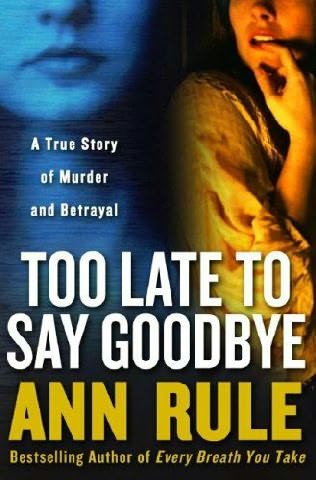
Too Late To Say Goodbye

- A True Story of Murder and Betrayal -


If you like crime drama, - and what American doesn’t, it seems, - then you are already familiar with Ann Rule and her excellent treatment of true crime. She has the ability to put together a captivating picture of a crime that readers are unable to put down til they’re reached the last page.

Her reputation is such that she is now in the enviable position of having people contact her to suggest real-life murders. They know if she decides to write about a crime, it will be presented in a most readable and gripping manner.

Too Late to Say Goodbye is no different. Page after page, the book yields the story of an incredible absorbing crime that almost went unsolved! It is a tangled story of betrayal, treachery and jealousy, and how a seemingly idyllic marriage can be terribly misleading.

The story begins a few weeks before Christmas 2004, in the upscale suburban community of Sugar Hill, Georgia. Jenn Corbin and her dentist husband, Bart, appeared to be a happy, loving couple - the parents of two young boys Dalton and Dillon. Bart was building his dental practice and Jenn was a preschool teacher and all seems right with their lives.

But as is so often the case, appearances can be very deceiving.

Bart Corbin was a guy who was far different in private than in the public eye. In addition to his controlling personality, he was also a womanizer. This combination was too much for Jenn to live with and eventually, though no one else knew it at the time, they separated. Shortly after Thanksgiving 2004 Jenn left their home and a divorce appeared to be imminent.

So when young 7 year old Dalton Corbin found his mothers body and ran to a neighbors for help, it wasn’t hard for investigators at the scene to believe they had a suicide on their hands with the way the scene was laid out in front of them. Everything about it pointed to a self-inflicted gunshot wound as the cause of death.

But even though Jenn’s death had all the ear marks of a suicide, the case dragged on and appeared to be headed to the cold case files of the Gwinnett County Police Department. The investigators were tenacious however and stayed with the case.

To their surprise, their investigations led them to another woman, Dorothy (Dolly) Hearn, who had been involved with Bart Corbin 14 years before and had met her death too, in circumstances remarkably similar to Jenn’s.
While one suicide could perhaps be explained, the odds of two women, romantically linked to the same man and taking their own lives were as remote as one person being struck by lightning on two separate occasions.

Not only that, but if a women chooses to end her life, she just doesn’t tend to shoot herself in the head. Statistically, it is not a mode many women choose to commit suicide. The red flags went up and the case stayed open.

But it doesn’t end with that. Was there a connection, or was there some answer to be found in a secret and even more dangerous relationship Jenn was having outside the marriage? In true form, Ann Rule interviewed virtually everyone in any way related to the story; the victims' families, police investigators, prosecutors, and sources stretching from Georgia all the way to Australia to uncover the truth behind the headlines of these two sensational deaths. And what emerges on the pages of this book is an incredible story of jealous rage; of mind-boggling circumstantes and a glut physical evidence that runs from the seductive to the macabre and to the almost unheard of forensic techniques.
Eventually we are led to the tragic and ironic discovery that motivated the killing - the absolute unraveling of one of the strangest murder investigations of our time.

Ann Rule has truly outdone herself with this one – she has topped what has been stellar work to date with another unequivocally great crime story.

Thursday, May 10, 2007

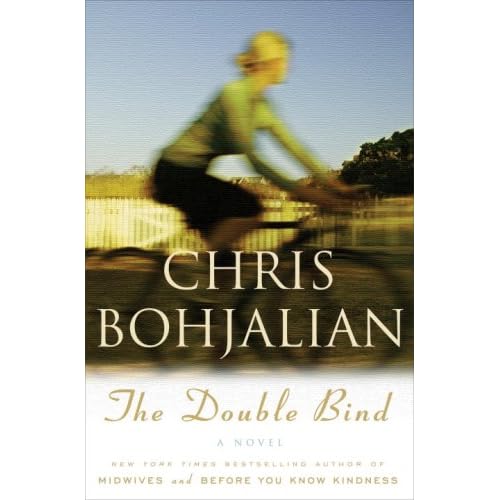
The Double Bind

If I had to give this book some sort of star rating out of five, I’d give it five and a half! Not only did it satisfy everything I look for when buying a book, but it added a perfect jacket illustration as well – my first thought was ‘is she going quickly or am I not seeing this clearly?’ It’s a blurred image of a young woman pedaling her bicycle. And it’s the perfect image for what's to be found within, and how our everyday perceptions can, and usually are blurred.

This is a tale of compassion, compulsion and obsession – the lines between wealth and poverty strongly defined à la Fitzgerald. And at times a gut-wrenching story of homelessness and the mentally ill.
The knocking down of assumptions previously held.

The Double Bind clarifies for the reader that things aren’t all black and white, but truth is often the shade of gray. Laurel, the heroine of this book says "You understood a person better in black and white." But as she quickly learns in her own life, things are not black and white at all! I applaud Bohjalian's ability to cut smoothly across the two, linking them and giving the reader a truer picture of lives as he leads us to explore the human psyche and how it fights to survive by any means.

Every character in this tale is truly memorable. It begins with a young college sophomore, Laurel Estabrook being attacked by masked thugs while cycling the rural roads of Vermont one evening. Previous to the attack, Laurel had been an outgoing young woman, but not surprising, the attack leaves her immediately withdrawn and introspective.

As she buries herself in her photography, she visits a homeless shelter and learns of the existence of Bobbie Crocker. Bobbie was a mentally ill gentleman who had been a resident of the shelter and who claimed he had once been a great photographer too.
He was shy about showing his work to anyone and has the photographs hidden safely away in a box. When Bobbie dies, Laurel gets possession of the box and discovers Bobbie was indeed telling the truth. The box is filled with photos of legends such as Chuck Berry and Eartha Kitt, Robert Frost and Jay Gatsby to name just a few.

As Laurel’s fascination moves towards obsession, her examination of the photos convinces her that some of his photographs reveal a deeply hidden, dark family secret. Her family. Her search for the truth will lead her further from her old life and into a cat-and-mouse game with pursuers who claim they want to save her.

I love Bohjalians use of black and white photos at the beginning of many of the chapters. He has chosen less than a dozen, but intersperses them into the book with no intent to tie to the story, perhaps only to jar the reader back to another plane once more.

The photos are in fact, the work of a once homeless, real photographer, Bob ‘Soupy’ Campbell, and as you study the photos, you ask yourself how a man of this talent could ever end up homeless and mentally ill. It’s the best question you can ask yourself, proving that these people aren’t oddities, they haven’t chosen this life, but in fact are victims of circumstance; their lives having fallen apart around them. And reminding us it can happen to any one of us.

Double bind is a medical term having to do with children receiving mixed or contradictory messages from their parents leading to a dysfunctional family situation. Sometimes it can occur outside the immediate family as well, leading to a major mental breakdown. I believe what Chris Bohjalian intended was not just to write a story to entertain, but to educate the reader as well. He was attempting to show us all what can so easily happen and to give compassion where needed. However, he has imbedded the message in a wonderfully written story.

You may feel once you’ve reached the last page, you want to go back to page one and begin again. I say this not because it’s a bad story, but because it’s that good! From the strangely lilting, almost poetic prologue, to the twisted ending which leaves you compelled to go back and absorb the story anew. But definitely read it at least once!

Monday, April 30, 2007

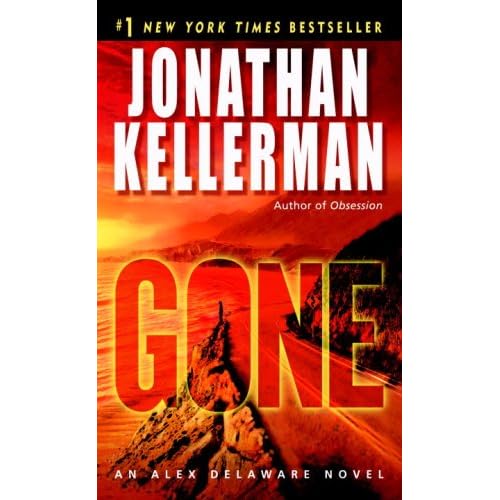
Another in the Alex Delaware series...


As I’ve mentioned in the past, I love character-driven series books and Gone is another superb Alex Delaware adventure brought to us by Jonathan Kellerman. This latest has Alex Delaware, an LA child psychologist, and sometime consultant to the police, and his good friend LAPD detective Lieutenant Milo Sturgis investigating the disappearance of a couple of young twenty-something acting students, Michaela Brand and Dylan Meserve, who met at an erstwhile LA acting school run by a wealthy actress wannabe. After Michaela turns up murdered and it’s learned that the disappearance was a hoax to gain attention for the pair, the investigation takes on a whole new complexity.

Delaware often has a very hands-on approach to solving his client's problems and this novel is no different. Also, Kellerman, himself being a former psychologist, can draw on a wealth of experience to pad out Delaware’s cases.

One thing I have always found very appealing about the entire Delaware series, is that Alex is such a close friend of Milos. Milo is an older, kind of out of shape, food loving, big bear of a guy who may make you think in terms of a milder version Andy Sipowicz. Indeed, the opposite of Alex Delaware.
He also happens to be gay.

Milo’s friendship with the straight Alex is handled extremely well – both men offering advice to the other at times regarding their relationships; Alex with his on-again, off-again girlfriend, Robin Castagna and Milo with his wonderfully solid relationship with Dr. Rick Silverman. The friendship adds some warmth and amusement to the otherwise bad business going on in these books. Kellerman weaves this subtle thread unobtrusively through every novel.

Gone takes us on a twisty tale of investigation, painstaking clue gathering and surprises cropping up just when you think you have everything figured out.
From beginning to end, nothing is entirely as it seems. The murder of Michaela may only be the tip of a murderous iceberg as the two men soon discover.
Another thing about Kellermans series’- each of the Delaware novels is a finished stand-alone product. They do not have to be read in any order, though I’m sure it would be more fun if they were. This book, like the rest, is just good, dependable reading. Kellerman weaves his plots beautifully, and nothing is ever ‘set up’ to make all the clues ‘work’.

I also love that Kellerman inserts places into each of his stories, making every incident real for those readers who have been there. In Gone, hoping a witness they've spoken to will open the case up for them, Milo & Alex arrange to meet him at Musso & Frank Grill. The restaraunt is an 80 year old Hollywood institution who’s claim to fame is Where the Stars Dine. Kellerman does this throughout this book as well as other books within the series.

Kellerman has once again published a novel which is perhaps better than the previous ones, but still promising there are better ones yet to come. It’s hard to imagine that he’s going to give us much better than this one! But until they come along, this one comes highly recommended!

Saturday, March 24, 2007

Got The Look - James Grippando


I admit it! I’m a serial reader. Better than being a serial killer you have to admit. I love books that bring you back again and again to your favorite people. Being one of those readers who loses herself in a book and becomes ‘friends’ with the characters I’m spending my time with, I always find it hard to let go of a story and say goodbye when the book is finished. I have at times delayed the finish of a really good book so I could avoid doing that.
Then I discovered I don’t always have to.

I can read John Lescroart (Dismas Hardy) or James Patterson (Alex Cross) and even Stephen White (Alan Gregory). I love them all and in pure voyeuristic fashion, I pick up the latest book to see what they’re up to now. And I don’t even watch soaps, imagine that.

So; bringing me to my latest read Got The Look. Author James Grippando, and his latest episode in the life of hot shot Miami criminal defense lawyer Jack Swyteck.

In Got The Look, Swyteck falls in love with the woman of his dreams: a gorgeous and obviously wealthy lady named Mia Salazar. Not all is perfect in paradise as he quickly discovers Mia is married to someone else. Being the class act that he is, assurances of the marriage being loveless and evidence of abuse notwithstanding, he terminates the relationship.
But when Mia is kidnapped a few weeks later, however, Swyteck is abruptly and reluctantly drawn back into her life and the investigation by Mia's husband and, more significantly, by FBI agent Andie Henning.

The kidnapper's modus operandi is to take someone and then send a note to the spouse stating "Pay me what she's worth." If the husband gets the dollar amount right, then his wife is released unharmed; but get it wrong and she is killed.

All this is further complicated by the fact that the FBI believes Mia may have a remote tie to her kidnapper. Swyteck is torn between following the FBI's plan and making up one of his own along the way, leading to some fast thinking by Swyteck's former client and permanent best friend, ex-con Theo Knight, who is there to assist him.

Between Theo, Mia, the Wrong Number Kidnapper, and a complex, intriguing and original plot with more than the expected number of twists and turns, you easily get wrapped up with everyone involved and tend to forget about Swyteck even when he is front and center. Someone else more interesting is always around to hold your interest.

I love how Grippando has the ability to set a scene so beautifully that at times I was living Mia’s terror so significantly, I had to set the book down and occupy myself with something else for awhile. Even though this book tends to slows the pace at times, you need that. Grippando is a true storyteller, a skill he has displayed over the course of his ten previous novels, all of which I’ve read and enjoyed.

With summer approaching, I would highly recommend this one for those hot summer afternoons. Then you may want to go back and find some of the other books by Grippando because I doubt you'll be disappointed.

Friday, March 02, 2007

Secrecy & Privilege by Robert Parry - click here to purchase

~
~


Tracing investigative leads back through three decades, Secrecy & Privilege explores the mystery of how the two George Bushes rose to the pinnacle of American political power - and what the rise of their dynasty has meant to the nation's democratic principles.

Suggesting to Americans that their country has a compelling lust for political, economic and military hegemony over the rest of the world, divorced from any moral considerations, is akin to telling them of one’s UFO abduction – except that they’re much more likely to believe the abduction story.

Well, I gotta tell ya! This is a book that picked my head for sure! I don't like to admit it; I wish it wasn't so; but it is and there's no point in my denying it.

Did you ever stop to ask yourself why the Bush family has risen to the heights they have and achieved the political success they’ve enjoyed, yet none of them have ever really held any position outside of politics? They’ve held political office for decades, but what else?
None of them, to a man, has ever succeeded in any other vocation or profession outside of politics! You have to ask yourself ‘how does this happen?’
This book steps you through the process that got them to their political stations.
Parry takes you through the last 30 years of Bush dominance (I hesitate to say dynasty) and lays out the events which led up to today and another term of Bush mismanagement.

From Watergate to Dubya today, as you will see, the phrase 'taking care of business' takes on a whole new meaning.

You can also be assured that Robert Parry is not just another author with an axe to grind. He has credentials. He is an American investigative journalist. Along side his AP partner Brian Barger, he was the first to report on Oliver North's activities in the White House basement, and the first to describe the Nicaraguan Contras' involvement with cocaine traffickers. He also was responsible for breaking a number of Iran-Contra stories.
He knows where he’s coming from.
Only Parry has had the sources, found the documents, and cogently compiled the deceptive history of how the Bush family have deliberately buried, under multi-layers of secrecy, the truth of some significant events in recent history.

He was there in 1976, when George H.W. Bush was Director of Central Intelligence, the head of the CIA. While few paid attention at the time, certain anti-Castro Cuban exiles, many with past and current ties to the CIA, were the only terrorists ever to export terrorism from the United States. In 1977, the CIA reported that these terrorists killed more people in 1976 than all of the Middle East terrorist groups combined. Yet when the FBI asked DCI Bush for help in quelling the Cuban exile attacks, he slammed down a brick wall on anything that might have come out of Miami. And those secrets are still sealed. That alone may give an unbiased observer a reason to understand the overwhelming support the Bush family receives from the Cuban-Americans in Miami.

In 1995, Parry established Consortiumnews.com as an online ezine dedicated to investigative journalism. From there to present, he’s delved into Colin Powell’s history, and brought attention to Sun Myung Moon and his plans for world domination.
Much of this are found within the pages of Secrecy & Privilege.

I cannot stress enough, if you’re not squeamish about learning the truth, then grab a copy of this book, a bottle of Pepto Bismol or a stiff drink, and read on. Parry has dragged the truth out from under the rocks and released this book of enlightenment for all.

Wednesday, February 28, 2007

Instance of the Fingerpost- A novel by Iain Pears


This is a powerhouse of a book and not for the faint of heart as we’re taken back to England in the mid 1660’s - 1663 to be exact - Oxford England at the height of Restoration. A bold display of class differences, monarchy, war and deception, treason and prison, poisoning and trials, public hangings, science versus religion, truth and lies. A plethora of autopsies, human and animal, transfusions. Just your typical renaissance romp.

Anyone knowing anything of this period, knows the civil unrest and the intrigues of the times. With Cromwell dead and the monarchy restored, England is in an uneasy period and even the hallowed cloisters of Oxford provide no refuge.

The place is New College, Oxford and a professor, Dr. Robert Grove is found dead in his college suite from what appears to be arsenic poisoning. A missing signet ring from the doctors’ hand quickly leads the officials to arrest a former chambermaid, a young and very comely Sarah Blundy. Though there is little investigation in the crime, Sarah, though innocent, quickly confesses to the murder and is hanged.
End of story? No; just the beginning. Was Sarah actually innocent?

Enter Marco da Cola, a visiting Venetian popinjay self-described ''gentleman of Venice,'' who is also trained in medicine, Cola is a dilettante physician of sorts. After learning of Sarah's ailing mother Anne, and being somewhat infatuated with Sarah, Marco begins treating Anne. The very Catholic Marco is intent on claiming credit for the invention of blood transfusion. He feels with the use of his discovery on Anne, he will be readily accepted into the medical fold of his peers.

Then there is Sarah's former lover Jack Prestcott, an undergraduate and man of violent passions, jailed for attacking his guardian and consumed with proving that his exiled father was hounded to his death, innocent of the charge of treason the returning monarch Charles II's supporters had lodged against him.

As we learn more about young Sarah, we are introduced to a wealth of possible murderers and through the telling by four different people, we get to the events leading up to the death of Dr. Grove.

Da Cola's account, opens the book, which introduces us to all major and most minor characters, his is followed by Jack Prestcott's account which exudes the bitterness of the wronged; then comes Dr. Wallis' account; he twists all events to conform to his paranoid world view. Dr. Wallis is a mathematician and cryptographer for three Kings and Parliament, and lives, eats and breathes cryptography. He believes he sees a sinister underlying truth in everything.

Finally there's Anthony Wood, an author. Wood comes across more sympathetically, much like in his autobiography (understandably; not many people think ill of themselves). He has a favorable opinion of himself, but inclines towards being uncharitable when discussing others. Wood's avocation renders him vital to the story; a pack rat, he spends his days cataloging and reading manuscripts in the Oxford library, when not deep into reading his books. A true historian, he desires only to show the truth as best he knows it.
All four accounts are believable, and they all tie-in to each other remarkably well.

Underlying it all are competing notions of truth. They relate the events surrounding a murder as they’ve come to understand it. Each has his own knowledge, perspective, and motive in his personal telling. Several prominent figures from history, John Locke and Robert Boyle among them, are also written in as participants to the action making the story more believable. There are citations from Francis Bacon, the father of the scientific revolution, to provide sign-posts to the continuing unfolding mystery.

This tale is entertaining and though long, Pears’ work as art historian, consultant and journalist enables him to lay out a compelling and intelligently written mystery…a search for real truth, precise and accurate in every word. Against this backdrop of English Restoration, Pears has woven a wonderful story of darkness and shadows. A must for anyone who likes good literature mixed with history and an exciting plot.

There are so many aspects to this book that I could write a review as long as the book just to cover them. If I have any criticism of this book, it’s that it is wordy and not what could be considered a page-turner. Because of the time it takes to get though it, this one is only for the serious readers who love the genre and good writing.

Having said that, I would highly recommend it for those that enjoyed
Umberto Eco's The Name of the Rose.

Tuesday, February 20, 2007

The hidden Abuses


The Hidden Abuses - help for the emotionally beaten

We tune in to the news every day or leaf through magazines and find articles about men who’ve physically maimed their wives and children - broken their bones or left them bloody and covered with bruises or worse, stabbed, strangled, or shot them to death. Neighbors and co-workers say they're nice guys, really pleasant, friendly guys who are just a treat to work beside, guys who will go that extra mile to lend a hand, who always wave when leaving for work in the morning and talk over the fence about how much they love their families.

This is awful stuff and just all too common in today’s world. That’s physical abuse. You read books about it and you see it in movies. We even have laws now that try to protect victims from being victimized again - restraining orders and things of that nature. This is the abuse that you can actually see.

But what about the other abuses? How do we protect others and ourselves against these? These abuses that kill the spirit and rob the body so that there's nothing left but an empty shell? I’m referring of course to verbal, emotional, and mental abuse. In some respects it can be worse than physical abuse. These are the abuses you can’t get a doctor to bandage and make heal. Unlike a bone, it won’t knit and get better. You can’t get it stitched and wait for it to heal.

Because verbal, emotional, and mental abuse is invisible, they don’t get swathed with bandages and treated with ointments. These abuses chip away at the very essence of a person and there are no laws to protect against it. Sometimes, too many times, even family members aren’t aware it’s happening because the abuser is a very gifted liar as well.

The person who is suffering from verbal abuse is not so easily recognized. She is the one who doesn’t want to say anything for fear of rocking the boat. She’s already learned from experience that to be forthcoming in any way will result in a verbal tirade she can’t emotionally handle.

She will make phone calls to explain why they haven’t gone to a party or why they are begging off a dinner engagement. She makes excuses to others for the embarrassing moments, telling friends that he’s just tired and not normally like that.

The friends readily accept this because they’ve seen what a swell guy he is.
That’s because verbal abuse is for all intents invisible. It goes on in private – behind closed doors. Out in the open, he’s Mr. Congeniality -- friendly and supportive to everyone -- but get him home alone with his wife and he is Mr. Hyde. He’s critical even of things that don’t exist; in fact, many times he creates things to be critical of. She forgot something he’d told her (he hadn’t). She’d put something of his away where he couldn’t find it and then forgotten where it was, (he himself put the item away). All these things were expertly invented to whittle away at the woman’s self-confidence. Then once it reaches a breaking point, he tells her he was joking and accuses her of being overly sensitive.

Slowly, these things sink in and she begins to question herself and worries that maybe that’s the case. Not being able to talk with anyone about it, she has no way of knowing if he’s right. He has her exactly where he wants her! Now he can manipulate and control. Whether she doesn’t work outside of the home and has some freedom, or a wage of her own, she is doomed! He is in full control of her entire existence.

It is at this time when he will start phase two: she is not going to get anyone to believe her because he’s already paved the way for family and friends to side with him. She is unreasonable. She is impossible to live with and he is the poor victim of all this. He is in full Mr. Wonderful mode - that poor guy with the difficult wife. From that point, she’s not in much of a position to even hope for help. When she weakly tries fighting back she’s a mean b!tch! Everyone sees her as unappreciative of his efforts to give her a good life. Everybody knows how much he does for her and how she’s not in the least grateful. Everyone knows this because that’s another road he’s paved. They readily take everything at face value and this is what has to change.

There is help. There are people who have been through this and they know the steps. Once a victim can even question for a moment what she's been led to believe about herself, this is a monstrous step to recovery. This takes some intervention from family and friends. Yes, there is great irony in that, because those that seem to have abandoned them really haven't. Like the victim, they've only been misdirected from the truth. That needs to be turned around. They can be brought to see what is taking place. It takes some close observation on the part of extended family and friends and some help learning not to take everything at face value.

There are some books which help step the abused through the first stages of getting help. Two I might suggest are Verbal Abuse: Survivors Speak Out by Patricia Evans.
Also by Ms. Evans, The Verbally Abusive Relationship: How to Recognize It and How To Respond

Both of these books are only a start in the right direction. But "The longest journey begins with but a single step".

Another excellent source of help are the online sites. Finding message boards and kindred spirits goes far in giving the abused person what she needs to fight back. Verbal Abuse is one site with numerous links for those seeking help.
Also, MentalHelp.net another excellent site in which to find support and advice.

Maybe, just maybe the day will come when these crippling abuses will garner as much attention as the other more obvious ones, then friends and family won't have to be taught how to look for it.

Without venturing to take that step, we are sentenced to forever remaining in bad places.

Saturday, February 17, 2007

Sacred Games by Vikram Chandra

My Book Report
by Ginger Haycox:

It's been awhile since I've used a heading like that, but Sacred Games truly made me feel like I had to qualify myself. It is so filled with plots, subplots and is so stoked in Indian history both today and yesterday, I feel that, like a student, I need to prove that I fully understood what I've just read. This book is hugely long (a tome at 900 pages) and you may momentarily find yourself lost or forgetting who is who; but only briefly.

I hadn't really read anything about India or based in India until now, so this was a both a teacher and a tale - most entertaining and enjoyable ones, as well. There's never any question of Chandra taking liberties with fact; there is never any doubt that he knows the city he's basing his epic on.

This is a story taking place in Mumbai (formerly Bombay), a modern Indian city with a darker side. Seven years of research went into getting this epic right, and that goal has been accomplished. Ambitious? Oh my, yes! And unapologetically melodramatic. But then, it is a novel and we look for this in storytelling.

You immediately become immersed in the life of detective Sartaj Singh — one of the very few Sikhs in the Mumbai police force, and his dealings with the criminal underworld; and with Ganesh Gaitonde, the most wanted gangster in India. Sartaj is past forty, his marriage dead and career prospects on the slide. We begin with him receiving an anonymous tip-off to the secret hideout of the legendary boss of the G-company, and he's determined he'll recoup his career by being the one to bag this gangster.

One thing Chandra does superbly well in this book is give a sense of the changes and the continuities of modern India. I like that we learn about things suffered by the Singh family, and how the book fleshes out and explains why characters became what they are. Gaitonde's own origins are equally as painful as Sartaj's, and totally convincing: the dreadful injustices of small-town life shape the monster he is to become.

In a story that takes you through friendship and cut-throat betrayal and extreme violence, Chandra has brought us a page-turner that resonates intelligence and is one of the best-written books I've read. The emotional depth of this book is astounding. Sacred Games' prose is just right for its purposes, the foul language fitting and vital.

If there are any flaws, they might lie in the abundance of subplots, some left without satisfactory resolution. But then, many life events are a little open-ended. I want to know the outcome of certain characters we come to know in the story, and I don't get full closure in that.

In any case, Sacred Games will be talked for a long time to come, and may be the measuring stick for many future books based in India.